
Comparing Silnylon, Silpoly, and Dyneema® for DIY Ultralight Tent Floors
Are you wondering which fabric to choose for the floor of your ultralight tent? Let’s compare three of the most popular options: Silnylon, Silpoly, and Dyneema® CT2K18. Find out which one best suits your needs.
Silnylon – The Classic of the Ultralight World
Silnylon (silicone-coated nylon) has long been a cornerstone fabric in the world of ultralight tents.
Advantages:
Lightweight – about 43 g/m²
Elastic – better resists point stress and stretching
Good waterproof rating – over 1500 mm
Budget-friendly – relatively inexpensive
Disadvantages:
Difficult to sew – the surface is slippery, making the sewing process tricky
Moderate abrasion resistance – not ideal for rough or rocky terrain
Less compact when packed – tends to trap air and puff up
Silpoly – The Hydrophobic Competitor
Silpoly+PU (silicone-coated polyester with a polyurethane layer) was developed to address some of the shortcomings of nylon. It’s more waterproof and less slippery, making it easier to work with and more reliable in wet conditions.
Advantages:
Similar weight to Silnylon – about 47 g/m²
Higher waterproof rating – over 3000 mm, making it more resistant to moisture and prolonged contact with wet ground
Disadvantages:
Slightly more expensive than Silnylon
Less elastic – handles point stress less effectively.
Dyneema® CT2K.18 – The No-Compromise Option
Dyneema® Composite Fabric (DCF) is the premium fabric of the ultralight world. Made from the strongest fiber in existence, it’s widely used by manufacturers who design gear meant to withstand the harshest conditions. The manufacturer recommends the CT2K.18 variant for tent floors, though you can also find tents on the market made from lighter versions of the fabric.
Advantages:
Similar weight to Silnylon – about 47 g/m²
Higher waterproof rating – over 3000 mm, making it more resistant to moisture and prolonged contact with wet ground
Disadvantages:
Slightly more expensive than Silnylon
Less elastic – handles point stress less effectively.
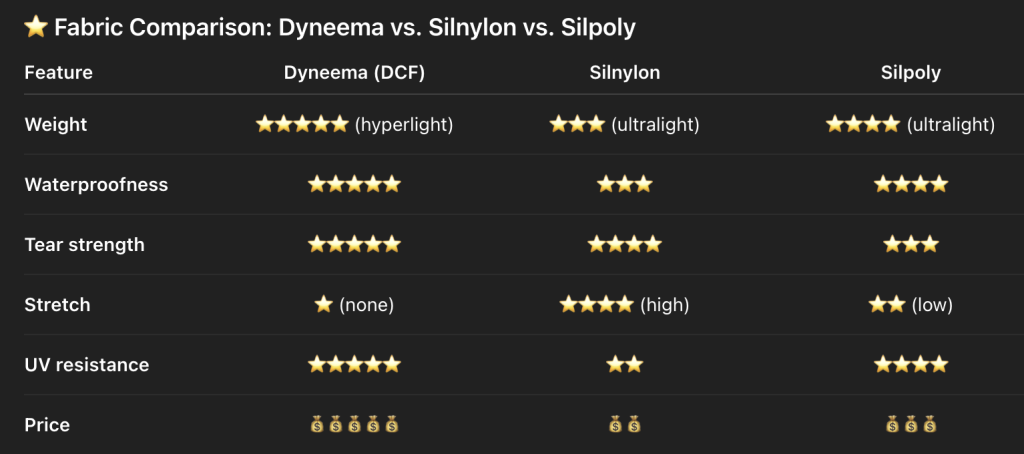
Quick Comparison:
We hope this comparison helps you choose the right material for your tent floor. If you’ve already completed your own projects, drop a few tips or sewing tricks in the comments—other makers will definitely appreciate it!
About
Articles are written by Aleksandra and Maciej. Sometimes when the subject is beyond their knowledge, they are seeking for professionals who help them out. If you want to learn more about us…read here

follow us:
Search
Zapisz się do naszego newsletter, żeby dostawać informacje o promocjach i nowych projektach
Sewing Ripstopn Nylon Fabric Ripstop is not an easy fabric to sew. It may require special needles, threads, and a different approach than classic, less slippery materials. Read our 7 tips to... read more →
23 October 2025
Which materials to choose for a hammock underquilt??
Hammock underquilt – choosing the materials Anyone who has slept in a hammock using only a sleeping bag knows how important insulation from underneath is. On cooler nights, an extra mat is... read more →

20 October 2025
Hammock underquilt with DIY down filling
How to sew a hammock underquilt – DIY, with down filling If you’ve decided on a project to make a hammock liner with down or feathers, you’re in for a lot of fun. All you need... ... read more →